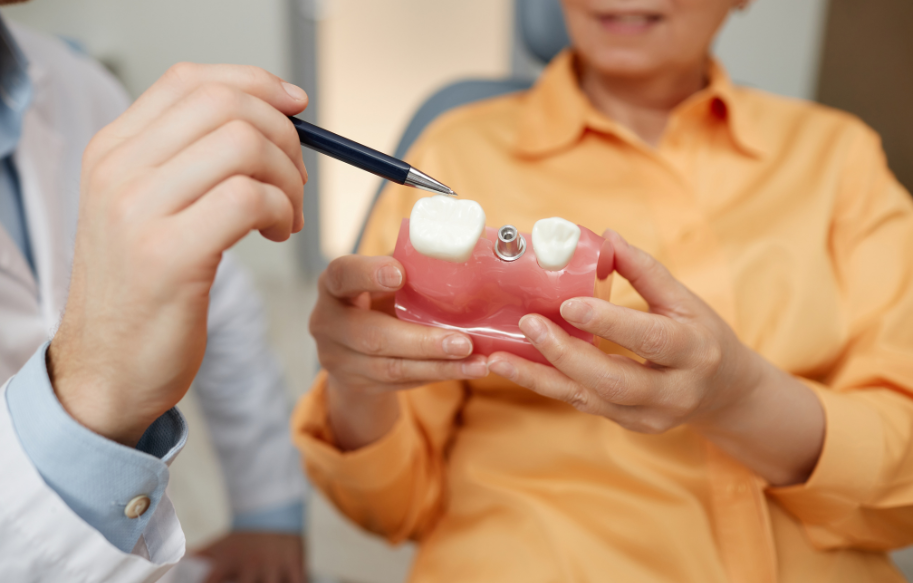
Dental implants are, on paper, the most life-like way to replace a missing tooth. But not every mouth is set up to receive one without thought. Before any implant is placed at Atrium Dental in Camberley, Dr Ahmed Al-Baiyaa carries out a risk assessment — a clinical filter that sorts who is a strong candidate from who needs preparation, an alternative, or, occasionally, a different plan altogether. This is what he looks for and why.
The first thing to know is that implants are not handed out on demand. Ahmed treats every consultation as a clinical decision, not a sales conversation.
“Before we decide to go ahead with an implant, we usually carry out a risk assessment, so it’s case by case. And most cases, if you don’t have any of the risk factors, then that would come out in your medical history.” — Ahmed Al-Baiyaa
The medical history is the single most useful document in that first appointment. Most patients sail through it. A small number do not, and it is far better to find that out before any surgery is planned.
There are a handful of factors that either lower the success rate of an implant or rule it out entirely until they are managed. Ahmed lists them clearly.
None of these are automatically a “no”. They are flags. Some can be managed — a smoker who stops before and after surgery has a much better chance of integration; a grinder might benefit from a nightguard to protect the result. The point is that the conversation happens openly, in advance.
“There are certain scenarios where the implant placement would still be okay, but it might carry more risk of potential failure. This is usually carried out in advance to filter out the patients that can have them and the patients that cannot.” — Ahmed Al-Baiyaa
For patients who pass the risk assessment, the numbers are genuinely reassuring. Implants are one of the most studied and predictable treatments in modern dentistry.
“If this is done with care, and the patients have stuck to the instructions given to them, the success rate of implants is actually above 95%, usually. So it’s quite a high success rate.” — Ahmed Al-Baiyaa
Two phrases in that sentence matter as much as the percentage. “Done with care” puts the responsibility on the clinician — careful planning, digital workflow, the right materials, sterile technique. “Stuck to the instructions” puts shared responsibility on the patient — aftercare, hygiene appointments, and not picking up new habits that put the implant at risk.
Patients almost always want a number. Ahmed is honest that there is no single answer — it depends on the mouth, the habits, and the bite.
What he can say with confidence is this: the implant screw itself, the titanium part that sits in the bone, is intended as a lifetime solution in the right patient’s mouth. The crown that sits on top is more like a natural tooth — it can chip, change colour over time, or simply wear in line with everything else in the mouth.
“The implant itself is meant to be a lifetime solution if it’s done in the right patient’s mouth, for sure.” — Ahmed Al-Baiyaa
For the crown, Ahmed’s expectation in a low-risk patient is at least ten years before any meaningful work is needed — often considerably more. If the patient is a heavy grinder, that timeline shortens; if a nightguard is worn and check-ups are kept, it lengthens.
It is worth being clear-eyed about this. A small minority of implants do not integrate, or develop problems later. When that happens, the issue almost always lives in the crown — the visible top — rather than the screw in the bone.
“You may find later on you may have some problems with the part of the implant that is superficial — so the crown that goes over the implant,” Ahmed explains. “Just like with your natural teeth, it may need some maintenance and repair in the future, if it chips, or if the colour changes.”
That maintenance is straightforward and usually quick. It is one of the reasons Atrium places such importance on aftercare and continuity — the implant is not handed over and forgotten about, it is reviewed and supported for as long as the patient is with the practice.
Some patients arrive convinced an implant is what they want, and a careful conversation reveals that something else — a bridge, a denture, or simply waiting — is a better fit. Atrium’s position on this is unusually clear.
“We are all about conservative treatment,” Ahmed says. The aim is to recommend what the patient needs, not what generates the largest invoice. Sometimes that means delaying treatment until a smoking habit is addressed, or until diabetes is better controlled, or until the patient is in a position to commit to the aftercare an implant deserves.
Working out whether you are a candidate is not something to guess at from a website. The most useful thing any patient in Camberley or Surrey can do is book a free consultation with Ahmed and have the conversation in person.
You can find more information on the dental implants page, or get in touch through the contact page. There is no obligation to book treatment — only to find out, honestly, where you stand.
With hundreds of 5-star reviews, we’re proud to be one of Melbourne’s most trusted names in dental and denture care.

5 months ago

I was recommended this dentist by my neighbour and I’m so pleased she gave me the recommendation. ... Read More

4 months ago
Very happy! I moved from another practice where I was a patient for 5 years. Firstly I was surprise... Read More

3 months ago
I was under the dental care of Matt Golightly some 20 year’s ago, as was my husband. Can honestly... Read More

6 months ago
I needed an emergency appointment and my own dentist couldn't offer one for 3 days. I rang Atrium wh... Read More

a month ago
Always a lovely experience at Atrium Dental. Front desk staff are always welcoming, the practice is ... Read More