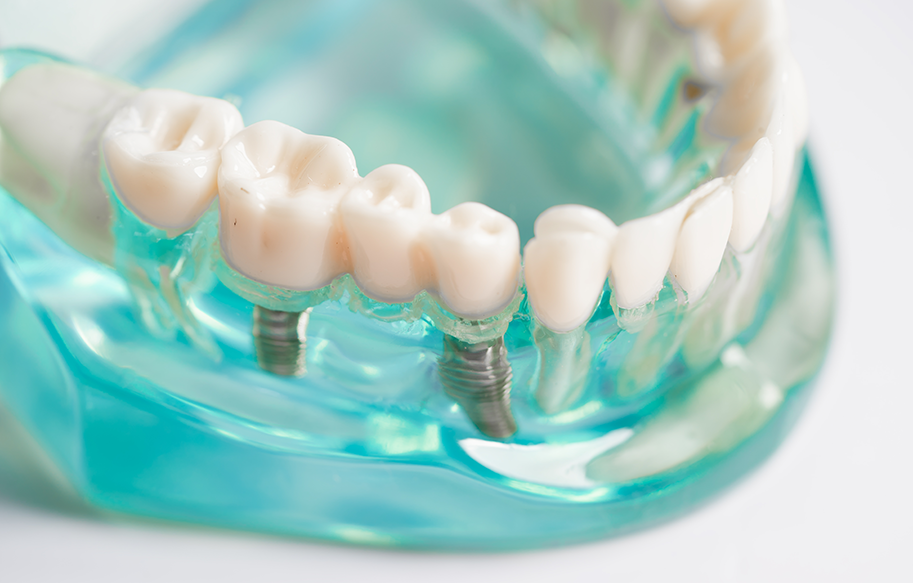
Dental implants are not new. What is new — over the past twenty years specifically — is how they are planned, placed and finished. Matt Golightly, principal dentist at Atrium Dental in Camberley, trained in implants at the Royal College of Surgeons and has been placing them in private practice ever since. He has seen the field change from a niche surgical discipline into something approaching mainstream restorative dentistry, and he has the perspective to explain what that progress actually means for patients.
When Matt trained, implant dentistry felt like a specialism that sat at the edge of general practice. It was already past its fledgling years, but it was a long way from being routine.
“Implant dentistry was the next stream to my boat — I was surgical anyway. Back when I started implants, it wasn’t fledgling, but it was a bit niche. I was honoured to get in on that.” — Matt Golightly
Two decades on, implants are no longer reserved for unusual cases. They are now widely recognised as one of the best long-term solutions for replacing a missing tooth — provided the patient is suitable and the work is well planned. The clinical principle hasn’t changed: a small titanium screw is placed into the jawbone, given time to integrate with the bone, and then restored with a crown that looks and functions like a natural tooth. What has changed is everything that supports that procedure.
If you want a single image that captures the gap between then and now, Matt has it ready.
“Back when I started implant dentistry, we’d have to send away down to Baker Street for a CT scan, wait for it to come back on a CD-ROM, and then try and work out the plan from there. Now we’ve got it in-house.” — Matt Golightly
That single change — having a CT scanner in the building — has compressed what used to be a multi-week planning loop into a single appointment. A patient considering implants at Atrium today can have a focused, 3D scan of the jaw taken in the room, reviewed on screen, and discussed with the dentist before they leave. There is no courier, no waiting period and no second visit just to look at the scan.
Why does that matter clinically? A CT scan shows the dentist exactly where the bone is, how dense it is, and where critical structures (nerves and sinuses, particularly) sit relative to the proposed implant site. With that information mapped in 3D, the implant can be planned with millimetre-level confidence — angle, depth, position — long before any incision is made.
The in-house CT scanner is the headline change, but it is only one part of the digital workflow Atrium runs.
“I was an early adopter of digital dentistry. I’ve been using the CEREC system for years and years. The move to digital is huge for us, and we’re at the forefront of that.” — Matt Golightly
A modern implant case at Atrium typically runs as follows.
The patient experience benefit is straightforward: fewer hand-offs, fewer appointments, and a clearer picture at every stage of what is actually being planned in the mouth.
The other quiet shift over Matt’s twenty years has been Atrium’s deliberate move to bring more of the patient journey under one roof.
“We try and keep everything in-house. Try not to refer anything out.” — Matt Golightly
Historically, an implant case might have meant a referral for the CT scan, a referral for the surgical placement, then back to the dentist for the crown — each step adding a wait, a new clinician and a new fee. At Atrium today, the scan, the surgical planning, the placement and the final restoration are handled by a team who all work in the same building and share the same notes. For root canal work, Matt Cottam — who is training at master’s level in endodontics — handles cases that would once have meant an outside referral. For implants, Ahmed Al-Baiyaa brings his MSc in Implant Dentistry to the surgical and restorative side, with Matt mentoring him through complex cases.
From a patient’s point of view, that is fewer journeys, fewer unfamiliar faces and one team taking continuous responsibility for the result.
If you have been living with a missing tooth, struggling with a denture, or weighing implants for the first time, the right question to ask is not whether implants work — they do, with high success rates in suitable patients. The right question is whether the practice you’re considering plans implants properly. An in-house CT scan, digital planning and a team that handles each stage of the journey are the modern markers of careful implant care.
To explore whether implants are the right option for you, book a consultation with the team for dental implants in Camberley. You can contact Atrium Dental directly to get started.
With hundreds of 5-star reviews, we’re proud to be one of Melbourne’s most trusted names in dental and denture care.

7 months ago

Very happy! I moved from another practice where I was a patient for 5 years. Firstly I was surprise... Read More

6 months ago
I was under the dental care of Matt Golightly some 20 year’s ago, as was my husband. Can honestly... Read More

8 months ago
I was recommended this dentist by my neighbour and I’m so pleased she gave me the recommendation. ... Read More

4 months ago
Always a lovely experience at Atrium Dental. Front desk staff are always welcoming, the practice is ... Read More

3 months ago
Thank you yet again…Matt and Jane …. for your supreme kindness and professionalism. My six month... Read More